Table of Contents
- Why a Simple Self-Care Routine for Men Matters
- Essential Grooming Routine for Men
- Daily Self-Care Habits for Men That Stick
- Men's Mental Health Self-Care Practices
- Self-Care Activities for Men on a Budget
- Physical Health and Exercise in Your Routine
- Sleep Hygiene and Recovery
- Building Your Routine: Common Mistakes to Avoid
Simple Self-Care Routine for Men: A Practical 2026 Guide
Last Updated: July 31, 2026
Building a simple self care routine for men doesn't require expensive products or hours at a spa. What matters is consistency, intentionality, and understanding that self-care is foundational to physical health, mental wellbeing, and emotional resilience. This guide walks you through the essentials: grooming basics, mental health practices, physical activity, and sleep hygiene that actually stick. Below, we'll show you exactly how to build a routine that takes less than 30 minutes daily and delivers real results.
Men who maintain consistent daily self-care routines report better stress management, improved sleep quality, and stronger emotional regulation. The challenge isn't knowing what to do, it's building habits that feel natural rather than forced.
Why a Simple Self-Care Routine for Men Matters
Taking care of yourself isn't vanity. It's maintenance.
Your body and mind need regular attention the same way your car needs oil changes. A simple self care routine for men addresses three critical areas: physical health, mental wellbeing, and emotional regulation. When these work together, everything else improves: work performance, relationships, energy levels, and resilience.
Men often skip self-care because they assume it's time-consuming or superficial. The truth is simpler: a 10-minute morning routine and 15-minute evening routine compound into measurable improvements. Better sleep means sharper focus at work. Consistent grooming builds self-esteem. Stress management techniques reduce anxiety and prevent burnout.
Many men grew up in environments where self-care was dismissed as weak or unnecessary. That mindset is outdated. Modern research consistently shows that men who prioritize grooming habits, mental health practices, and physical activity report higher life satisfaction and lower rates of depression and anxiety.
Essential Grooming Routine for Men
A grooming routine is where most men start because it's visible and immediate. The foundation is simple: cleanser, moisturizer, and basic hair maintenance. These three elements take less than five minutes and form the basis of healthy skin.
Face Care Basics: Cleanser and Moisturizer
Start with a cleanser designed for your skin type, not bar soap, which strips natural oils. Wet your face with lukewarm water, apply a quarter-sized amount of cleanser, massage gently for 30 seconds, and rinse thoroughly. Do this twice daily: morning and evening.
Follow with moisturizer while your skin is still slightly damp. This locks in hydration and protects your skin barrier. If you have oily skin, use a lightweight gel moisturizer. If your skin is dry, use a heavier cream. Consistency matters more than product choice.
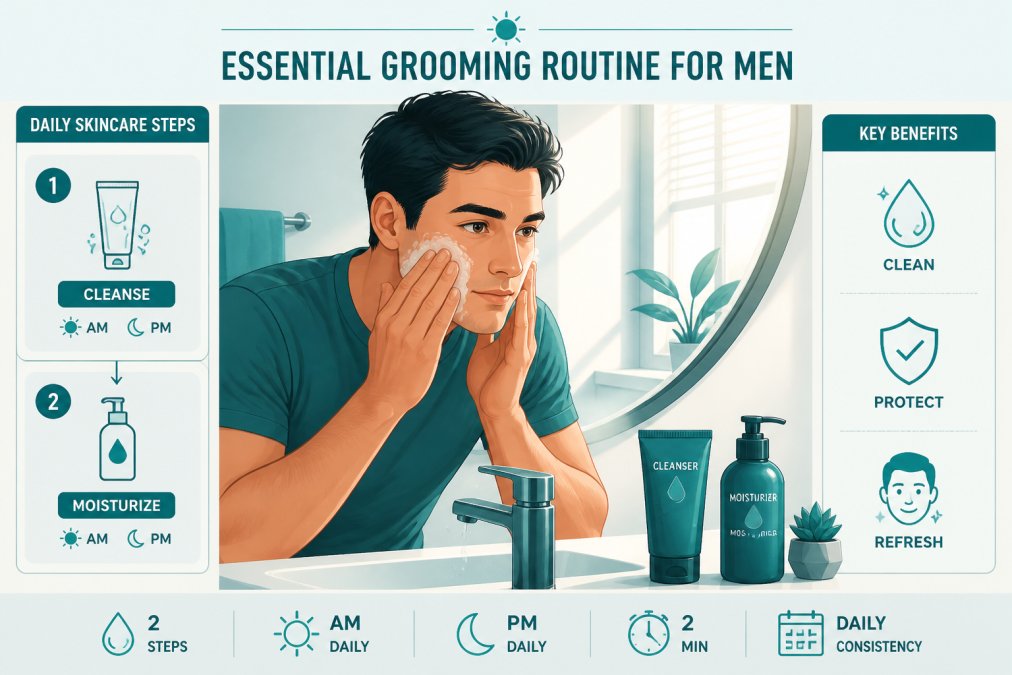
Many men skip moisturizer because they think it's unnecessary or "feminine." Moisturized skin looks healthier, ages better, and feels more comfortable. It takes 30 seconds and costs under $15 for a month's supply.
:::pro tip Apply moisturizer to damp skin, not dry skin. Damp skin absorbs products better and you'll use less product overall. :::
If you struggle with acne, add a targeted treatment after cleansing but before moisturizing. If you're concerned about aging, add a simple retinol product 2-3 times per week.
Hair and Beard Maintenance
Hair maintenance depends on your style, but the basics remain constant: wash regularly, condition if needed, and keep it trimmed every 3-4 weeks.
Use a shampoo formulated for your hair type. If you have oily hair, wash daily. If you have dry or textured hair, wash 2-3 times weekly. Always condition after shampooing to prevent dryness and frizz.
For beards, wash with a beard-specific cleanser 2-3 times weekly and condition with beard balm or oil to keep hair soft. Trim the edges every 2-3 weeks to maintain shape. Keep your nails trimmed short and clean.
Daily Self-Care Habits for Men That Stick
A routine only works if you actually do it. The secret to consistency is building habits so small they feel automatic.
Morning and Evening Rituals
Your morning ritual sets the tone for the entire day. Start with: wake up, drink water, do your grooming routine (cleanser, moisturizer, basic hair care), and get dressed. This takes 10-15 minutes.
Add one small element: five minutes of deep breathing, light stretching, or a cold shower. A cold shower activates your parasympathetic nervous system and builds resilience. Five minutes of stretching improves flexibility and reduces stiffness. Deep breathing (five slow inhales, five slow exhales) calms your nervous system before the day starts.
Your evening ritual prepares for quality sleep. Two hours before bed, dim the lights and reduce screen time. Thirty minutes before bed, do your grooming routine. This creates a boundary between "day mode" and "sleep mode."
Hydration and Basic Nutrition
Hydration is the easiest self-care practice and the one most men neglect. Drink half your body weight in ounces of water daily. A 180-pound man should drink 90 ounces (about 2.7 liters).
Start your morning with 16 ounces of water before coffee. Drink water throughout the day, especially before and after exercise.
Nutrition doesn't require perfection. Eat protein with every meal (eggs, chicken, fish, beans, yogurt). Eat vegetables with lunch and dinner. Limit processed foods to occasional treats. Breakfast should include protein and complex carbs to prevent mid-morning energy crashes.
Men's Mental Health Self-Care Practices
Physical self-care is visible and easy to track. Mental health self-care is invisible but equally important. Emotional intelligence is a skill that improves with practice.
Stress Management and Deep Breathing
Stress accumulates throughout the day. Without a release mechanism, it builds into anxiety, poor sleep, and irritability. Deep breathing is the simplest tool available.
Try the 4-7-8 technique: inhale for four counts, hold for seven counts, exhale for eight counts. Do this five times when you feel stressed. It activates your parasympathetic nervous system and reduces cortisol, your primary stress hormone.
Do this once in the morning and once in the evening, regardless of stress levels. Identify your stress triggers and address them directly. If work stress is your primary trigger, set boundaries: stop checking email after 6 PM. Physical activity is one of the most underrated stress management tools. A 20-minute walk, run, or weight training session reduces cortisol more effectively than most meditation practices.
Journaling and Self-Reflection
Journaling is a practical tool for processing emotions and identifying patterns.
Spend five minutes each evening writing three things: one thing that went well, one challenge you faced, and one thing you learned. This trains your brain to notice positives, process difficulties, and extract lessons.
You don't need fancy journals or perfect writing. Stream of consciousness is fine. The goal is externalization, getting thoughts out of your head and onto paper so you can see them clearly.
:::pro tip If traditional journaling feels uncomfortable, try voice journaling. Record yourself speaking your thoughts for five minutes. Same benefits, less writing. :::
Self-Care Activities for Men on a Budget
The best self-care routine is one you can afford and sustain.
Walking is free and one of the most underrated forms of self-care. A 20-30 minute walk daily improves cardiovascular health, reduces stress, and clears your mind.
Bodyweight exercises (push-ups, pull-ups, squats) require no equipment and build strength. A 15-minute routine three times weekly delivers measurable results.
Meditation apps like Insight Timer offer free guided meditations. Start with 5-10 minutes daily.
For grooming, basic products from drugstores work fine. A $5 cleanser and $5 moisturizer are perfectly adequate. Hutch's Beauty Boutique offers affordable options across all categories, making it easy to build a complete routine without breaking your budget.
Social self-care is critical. Schedule regular time with friends or family. Coffee with a friend, a walk with a family member, or a phone call with someone you care about all count. Men often isolate, which amplifies stress and depression. Regular social connection is non-negotiable self-care.
Physical Health and Exercise in Your Routine
Exercise is self-care. Regular physical activity improves cardiovascular health, builds muscle, increases bone density, improves sleep quality, and reduces anxiety and depression.
You don't need to be a gym enthusiast. Start with 150 minutes of moderate activity weekly (about 30 minutes, five days per week). This could be brisk walking, cycling, swimming, or any activity that elevates your heart rate.
Add strength training two days per week. You don't need a gym; bodyweight exercises at home work perfectly.
The key is consistency over intensity. A moderate routine you maintain for years beats an intense routine you quit after three months.
| Activity | Duration | Frequency | Benefits |
|---|---|---|---|
| Brisk walking | 30 minutes | 5x weekly | Cardiovascular health, stress relief, low injury risk |
| Strength training | 30-45 minutes | 2-3x weekly | Muscle building, bone density, metabolism |
| Stretching | 10 minutes | Daily | Flexibility, injury prevention, relaxation |
| High-intensity intervals | 20 minutes | 1-2x weekly | Cardiovascular fitness, time efficiency |
Sleep Hygiene and Recovery
Sleep is where your body repairs itself and consolidates memories. Poor sleep undermines everything else: nutrition, exercise, mental health, and emotional regulation.
Consistency: Go to bed and wake up at the same time daily, even on weekends. After two weeks of consistent sleep timing, you'll fall asleep faster and sleep deeper.
Darkness: Your bedroom should be completely dark. Use blackout curtains or an eye mask.
Temperature: Keep your bedroom cool, around 65-68°F (18-20°C).
No screens: Stop using screens one hour before bed. Read, journal, or do light stretching instead.
No caffeine after 2 PM: Caffeine has a half-life of 5-6 hours, meaning half the caffeine you consume at 2 PM is still in your system at 8 PM.
No alcohol before bed: Alcohol destroys sleep quality. You'll wake up tired even after eight hours.
Implement one or two changes at a time, and after two weeks, add another. Within a month, your sleep quality will improve dramatically.
Building Your Routine: Common Mistakes to Avoid
The biggest mistake is trying to change everything at once. Use the "habit stacking" approach: attach new habits to existing ones. If you already shower every morning, add moisturizer to that routine.
The second mistake is perfectionism. You'll miss days. What matters is resuming the next day without shame or guilt. Consistency over perfection always wins.
The third mistake is choosing routines that don't match your lifestyle. Your routine should enhance your life, not create stress.
Start with the absolute minimum: a five-minute morning grooming routine and a five-minute evening routine. Add one element weekly: hydration one week, a 10-minute walk the next, journaling the following week. After a month, you'll have a solid foundation that feels automatic.
Tell someone about your routine. Accountability dramatically improves consistency. Text a friend your daily walk, share your journal insights with a therapist, or join an online community. Social connection amplifies motivation.
Frequently Asked Questions
What should a basic self-care routine for men include?
A simple self-care routine for men typically covers four core areas: grooming (face care with cleanser and moisturizer, hair maintenance), physical health (regular exercise and hydration), mental well-being (stress management and journaling), and quality sleep. You don't need expensive products, focus on consistent daily habits. Start with a 10-minute morning routine and a 15-minute evening wind-down, then expand based on your needs and schedule.
How can I build daily self-care habits for men that actually stick?
Anchor new habits to existing routines. If you shower every morning, add a two-minute face cleanser and moisturizer step immediately after. Start with one or two habits, not five. Track them on a calendar or phone app for two weeks to build momentum. Set a specific time (e.g., 7 a.m.) rather than a vague goal like 'sometime in the morning.' Small wins compound, consistency beats perfection.
What are affordable ways to practice men's mental health self-care?
Mental health self-care doesn't require paid apps or therapists to start. Free practices include deep breathing exercises (5 minutes daily), journaling (pen and paper), walking outdoors, and social connection with friends or family. Mindfulness meditation apps often have free versions. If you need professional support, check whether your employer offers an Employee Assistance Program (EAP), which typically provides free counseling sessions. Emotional regulation and self-compassion are built through daily practice, not expensive tools.
How long does a self-care routine for men need to be?
You can start with 15-20 minutes daily: 5 minutes grooming (cleanser, moisturizer, hair), 5 minutes exercise or stretching, and 5-10 minutes for mental health (breathing, journaling, or meditation). Micro-routines of 2-3 minutes work if you're extremely busy, even a quick cleanser, hydration check, and two minutes of deep breathing count. The goal is consistency, not duration. A 10-minute daily routine beats a 60-minute routine you abandon after two weeks.
Building a simple self care routine for men is straightforward once you remove the shame and complexity. Start small, stay consistent, and add elements gradually. The routine that works is the one you actually do, not the perfect one you read about. Hutch's Beauty Boutique offers everything you need, affordable cleansers, moisturizers, and grooming tools, all in one place. Get started with your first routine today and track how you feel after 30 days of consistency.
This article was written using GrandRanker


