Table of Contents
- Ultrasonic vs Evaporative Humidifiers: What's the Difference?
- Ultrasonic vs Evaporative: Quick Comparison Table
- How Each Type Adds Moisture to the Air
- Noise Levels and Energy Consumption
- White Dust from Ultrasonic Humidifiers: What to Know
- Maintenance Costs: How to Clean a Humidifier and Filter Needs
- Choosing the Best Humidifier for Bedroom Use
- Which Type Should You Buy?
- Frequently Asked Questions
Last Updated: September 9, 2026
Ultrasonic vs Evaporative Humidifiers: What's the Difference?
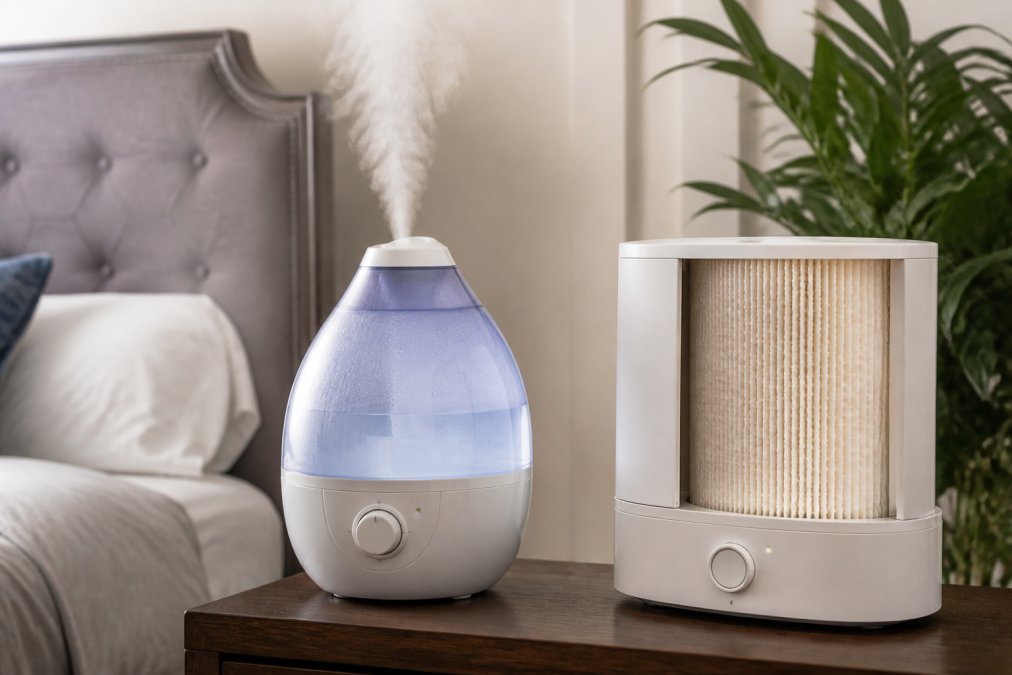
The difference between ultrasonic and evaporative humidifiers comes down to how each machine turns water into moisture. Ultrasonic models use high-frequency vibrations to create a cool mist, while evaporative units rely on fan-assisted evaporation through a wick filter. Both raise the relative humidity in a room, but they do it with different trade-offs in noise, maintenance, and air quality.
If you're shopping for relief from dry air symptoms like scratchy throats or static shock, the choice matters more than you might think. The wrong pick can mean weekly scrubbing or a fine mineral dust coating your nightstand.
Below, we'll break down how each works, what they cost to maintain, and which one belongs in your bedroom.
Ultrasonic vs Evaporative: Quick Comparison Table
Here is the short version of the humidifier differences before we dig into the details:
| Feature | Ultrasonic | Evaporative |
|---|---|---|
| How It Works | High-frequency vibrations create mist | Fan blows air through a wet wick filter |
| Noise Level | Near-silent | Audible fan hum |
| White Dust | Possible with hard tap water | None |
| Filter Needed | No | Yes, replace regularly |
| Energy Use | Lower | Slightly higher |
| Best For | Bedrooms, nurseries | Large rooms, allergy concerns |
The table shows the core humidifier differences at a glance. Now let's examine why these distinctions matter in practice.
How Each Type Adds Moisture to the Air
The technology behind each type determines everything else: the noise it makes, the particles it may release, and what you'll need to clean.
Ultrasonic Humidifiers: High-Frequency Vibrations
Ultrasonic humidifiers use a ceramic plate vibrating at high frequency to break water into a fine mist. A small fan pushes that mist into the air, where it evaporates and raises the moisture level.
Because there's no bulky fan moving large volumes of air, these units run nearly silent. That makes models like the Levoit Classic 300S Ultrasonic Smart Humidifier popular for bedrooms and office spaces where noise is a concern. Many also include auto-shutoff when the water reservoir runs dry and some offer smart home integration for scheduling from your phone.
Evaporative Humidifiers: Fan-Assisted Evaporation
Evaporative humidifiers pull air through a saturated wick filter using a fan. The water naturally evaporates off the filter's surface, and the fan circulates that moisture throughout the room.
This method is self-regulating: as the room's relative humidity rises, the evaporation rate slows, which means the unit won't over-humidify. The Vornado Evap40 excels here, using deep-pitched blades to move moisture across larger square footage. The trade-off is an audible fan hum and the need to replace the wick filter periodically.
Noise Levels and Energy Consumption
Ultrasonic models win on noise, plain and simple. The Levoit Classic 300S operates at whisper-quiet levels because the only sound is the subtle vibration of the plate and a gentle fan. Evaporative units like the Vornado Evap40 have a three-speed fan that you'll hear, especially on higher settings.
Energy consumption also favors ultrasonic technology. The mist production requires less power than running a fan strong enough to pull air through a wet filter. Over a full winter of nightly use, that difference shows up on your utility bill, though it's modest for both types.
That said, evaporative units aren't unpleasant to sleep with. Many people find the low fan noise soothing, similar to a white noise machine. If you're an extremely light sleeper, ultrasonic is the safer bet for your bedroom.
White Dust from Ultrasonic Humidifiers: What to Know
White dust is the most common complaint about ultrasonic humidifiers, but the problem isn't the technology itself, it's the water you feed it. To understand why, you need to look at what's actually in your tap water.
The Mineral Mechanics Behind the Dust
Ultrasonic humidifiers atomize water into microscopic droplets using a rapidly vibrating ceramic plate. When your tap water contains dissolved minerals, primarily calcium and magnesium, those minerals don't evaporate with the water. They remain suspended in the mist droplets. As those droplets evaporate into your room's air, the minerals are left behind as a fine, white powder that settles on furniture, electronics, and floors.
Municipal water hardness varies dramatically across the United States. The U.S. Geological Survey classifies water with 61-120 mg/L of calcium carbonate as "moderately hard" and anything above 180 mg/L as "very hard (usgs.gov)." If you live in a region with hard water, common across the Midwest and Southwest, you'll see visible white dust within days of using an ultrasonic unit with tap water.
Why Evaporative Units Don't Have This Problem
Evaporative humidifiers pull air through a saturated wick filter. As water passes through the wick, the filter traps the dissolved minerals before they can become airborne. Over time, those minerals accumulate on the filter itself, which is why wick filters become crusty and hard, and why they need regular replacement.
This doesn't mean evaporative units are maintenance-free. The minerals still collect somewhere; they just collect in the filter instead of on your nightstand. That's a trade-off worth understanding: ultrasonic moves the mineral problem to your furniture, while evaporative moves it to your wallet via more frequent filter changes.
The Distilled Water Calculation
Using distilled water in an ultrasonic humidifier eliminates white dust almost entirely. Distilled water has been boiled and re-condensed, leaving mineral content near zero. But that purity comes at a price.
A gallon of distilled water typically costs $1.50 to $2.50 at grocery stores across the United States (eia.gov). A standard ultrasonic humidifier with a 1.5-gallon tank will consume that much water in roughly 12-24 hours of operation, depending on output settings. If you run your humidifier nightly through a four-month winter, that's roughly 120 gallons of distilled water, an annual cost of $180 to $300.
A countertop water distiller, priced between $80 and $150, can produce a gallon in about four hours. If you're committed to ultrasonic technology and have hard tap water, a distiller pays for itself within a single season.
An Alternative: Inline Filtration
Some newer ultrasonic models include a demineralization cartridge that sits in the water tank. These cartridges use ion-exchange resin to capture calcium and magnesium before the water reaches the vibrating plate. They work reasonably well, but they're a consumable, expect to replace them every 30-60 days at a cost of $10-$15 per cartridge.
Testing Your Water Before You Decide
Before choosing between ultrasonic and evaporative, test your tap water. A simple home water hardness test strip kit costs under $10 at most hardware stores. If your test shows hardness above 120 mg/L, factor the distilled water cost or demineralization cartridge expense into your decision. If your water tests soft, below 60 mg/L, white dust will be minimal, and ultrasonic becomes a more attractive option.
Maintenance Costs: How to Clean a Humidifier and Filter Needs
Both humidifier types demand regular maintenance, but the nature of that work, and its true cost over time, differs significantly. Understanding the full picture requires looking beyond the purchase price to the total cost of ownership over several years.
The Bacterial Growth Risk in Stagnant Water
Any humidifier that holds water for extended periods creates a potential breeding ground for microorganisms. The U.S. Environmental Protection Agency recommends emptying and drying humidifier tanks daily to prevent bacterial and mold growth (the EPA). This isn't a suggestion, it's a health necessity, particularly for households with children, elderly residents, or anyone with asthma or allergies.
Ultrasonic humidifiers present a specific concern: the mist they produce can carry bacteria and mold spores directly into your breathing air. If you let a tank sit for several days, you're not just risking white dust, you're potentially aerosolizing microbial growth. Evaporative units have a similar risk, but the wick filter acts as a partial barrier, trapping some larger particles before they reach the air.
The Real Cost of Cleaning Supplies
A proper cleaning routine requires white vinegar or a commercial humidifier cleaner, plus a soft brush for scrubbing. White vinegar costs roughly $3 per gallon, and a thorough weekly cleaning uses about a cup per application. That works out to roughly $12-$20 per year in vinegar alone.
Commercial cleaning solutions like the Essick Air Bacteriostat Treatment cost about $8-$12 per bottle and are added to the water tank with each fill. If you follow the manufacturer's instructions, that's another $40-$60 per season.
Three-Year Total Cost of Ownership Comparison
Let's build a realistic three-year cost model for a typical household running a humidifier nightly during a four-month winter season (120 nights per year).
Ultrasonic Model:
- No filter replacements: $0
- Cleaning supplies (vinegar + brush): $45 over three years
- Distilled water (if you have hard water): $540-$900 over three years
- Electricity (estimated 25 watts, 8 hours/night, at the U.S. average of $0.17/kWh): roughly $12 over three years
- Three-year total: $137-$1,037 (the wide range depends entirely on your water source)
Evaporative Model:
- Wick filter replacements (2-4 per year at $15-$25 each): $90-$300 over three years
- Cleaning supplies: $45 over three years
- Electricity (estimated 60 watts, 8 hours/night): roughly $29 over three years
- Three-year total: $264-$474
The takeaway: evaporative humidifiers have a more predictable cost profile. Ultrasonic units can be cheaper, but only if you have soft water or are willing to buy distilled water consistently.
Cleaning Frequency by Type
| Task | Ultrasonic | Evaporative |
|---|---|---|
| Empty and dry tank | Daily | Daily |
| Vinegar descaling | Weekly | Weekly |
| Filter replacement | Never | Every 1-3 months |
| Deep clean with brush | Monthly | Monthly |
Signs You're Not Cleaning Enough
If you notice a musty smell near your humidifier, visible slime in the tank, or worsening allergy symptoms in your household, you're not maintaining the unit properly. The U.S. Consumer Product Safety Commission has documented cases where poorly maintained humidifiers contributed to indoor air quality problems, particularly in nurseries.
Choosing the Best Humidifier for Bedroom Use
The best humidifier for bedroom use depends on your room size and noise tolerance. For a standard bedroom up to roughly 300 square feet, a compact ultrasonic model works well. It's quiet, affordable, and includes a night light and 360-degree mist nozzle for directional control.
For larger master bedrooms or open layouts, an evaporative unit with a bigger water tank capacity provides longer run times. An evaporative unit can humidify a substantial area, but you'll hear the fan.
Consider your water source too. If you have hard tap water and don't want to buy distilled, an evaporative model eliminates the white dust issue entirely. If you're in a rental with soft water, ultrasonic gives you whisper-quiet operation without the filter costs.
Which Type Should You Buy?
Choose ultrasonic if you want near-silent operation, lower energy use, and no ongoing filter costs. Just be ready to use distilled water if your tap water runs hard.
Choose evaporative if you're humidifying a large area, want zero white dust, or prefer a self-regulating system. You'll pay for replacement wick filters, but the air quality benefits justify the cost for many households.
For most people, the deciding factor comes down to this: how much do you value silence, and how hard is your water? Answer those two questions and the right choice becomes clear.
At Hutch's Beauty Boutique, we stock humidifiers and wellness essentials designed to make your home more comfortable year-round. Whether you need relief from dry air symptoms or want to protect your skin and respiratory health through winter, browse our collection to find the right match for your space. Search our catalog today and get the humidity level your home deserves.
Frequently Asked Questions
Why avoid ultrasonic humidifiers?
The main reason to avoid ultrasonic humidifiers is white dust. If you use tap water, minerals like calcium and magnesium are released into the air as fine particles that settle on furniture. This happens because the ultrasonic transducer breaks water down into tiny droplets, and the minerals don't evaporate. Using distilled water eliminates the issue, but that adds a recurring cost. If you don't want to buy distilled water regularly, an evaporative model is the better choice.
What is the healthiest type of humidifier?
For health, evaporative humidifiers are often the safer choice. They use a wick filter and fan-assisted evaporation, which traps minerals in the filter so they never enter the air. This means no white dust and fewer airborne particles. Many evaporative models also include UV light to help kill bacteria in the water reservoir. The key to keeping any humidifier healthy is consistent cleaning to prevent mold and bacterial growth, regardless of the type you choose.
Are evaporative humidifiers more effective than ultrasonic models?
Evaporative humidifiers are generally more effective at humidifying larger rooms because the fan actively circulates moistened air throughout the space. They also self-regulate: as relative humidity rises, the evaporation rate naturally slows. Ultrasonic models can be just as effective in smaller areas like bedrooms but may require more precise control. For whole-home or large living area coverage, evaporative technology usually wins on effectiveness.
Do ultrasonic humidifiers leave white dust on furniture?
Yes, ultrasonic humidifiers can leave white dust on furniture if you use tap water. The high-frequency vibrations create a fine mist that carries mineral deposits into the air. As the water droplets evaporate, those minerals settle on nearby surfaces as a fine, chalky residue. Switching to distilled water prevents white dust completely. An evaporative humidifier also solves this problem because its wick filter captures the minerals before the air is released.
How often do you need to clean an evaporative humidifier?
Plan to clean an evaporative humidifier every three days when it's in regular use. Empty the water reservoir and wipe down all surfaces with a mild cleaning solution to prevent mold and bacterial growth. The wick filter needs replacement roughly every one to three months, depending on water hardness and how often you run the unit. Regular cleaning keeps the evaporation rate high and prevents unpleasant odors from developing in the filter.


