Table of Contents
- What You'll Need Before You Start
- Step 1: Set Up Your Aromatherapy Diffuser Correctly
- Step 2: Add Essential Oils at the Right Concentration
- Best Essential Oils for Relaxation and Calming Properties
- How Long to Run Diffuser for Sleep and Daytime Calm
- Essential Oil Diffuser Safety Tips for Pets and Kids
- Cleaning, Descaling, and Maintenance for Longevity
- Common Mistakes That Kill the Relaxation Effect
- Frequently Asked Questions
Last Updated: September 13, 2026
What You'll Need Before You Start
Most disappointing "relaxation sessions" fail before the diffuser is plugged in. An aromatherapy diffuser setup needs very little: an ultrasonic diffuser, room-temperature water, one or two essential oils you enjoy, and a surface out of reach of pets and small children.
Here's your starting checklist:
- An ultrasonic diffuser with an auto-shutoff feature
- A bottle of therapeutic grade essential oil (lavender is the safest starting point)
- Room-temperature water, never hot
- A stable surface at least a meter from your bed or chair
- A timer or the diffuser's built-in intermittent diffusion setting
Below: setup, dosage, timing, safety, and the mistakes that cancel out the calming effect.
Step 1: Set Up Your Aromatherapy Diffuser Correctly
Placement and water temperature decide how well your diffuser performs. Fill the reservoir to the fill line with room-temperature water, add oil, then set it on a stable surface away from direct sun, vents, and electronics.
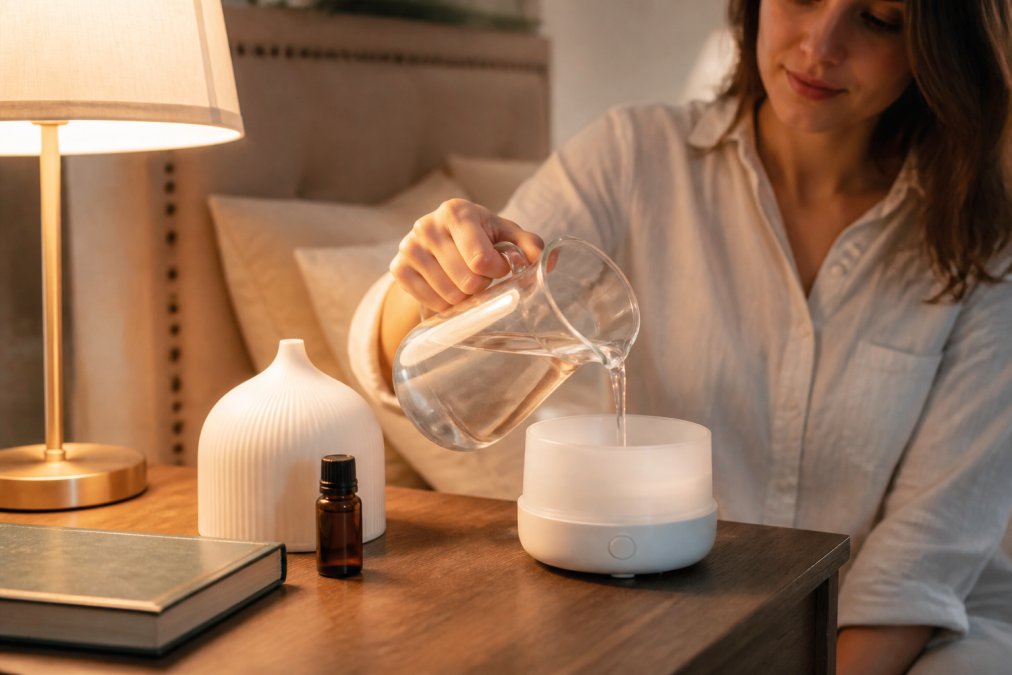
Fill Line, Room-Temperature Water, and Placement
The fill line exists for a reason: overfilling dilutes the oil and weakens mist output, while underfilling triggers the auto-shutoff early.
Room-temperature water matters more than most guides admit. Hot water degrades aromatic compounds before they reach the air; cold water slows the ultrasonic plate and drops mist output. Tap water works, but in hard-water areas, filtered or distilled water slows the mineral buildup that kills the unit.
Aim for one to two meters from where you sit or sleep: too close and the oil concentration becomes overwhelming, too far and you won't notice the scent. Keep it off the floor, away from curtains, and out of reach of pets and children.
Step 2: Add Essential Oils at the Right Concentration
The right dosage is three to five drops per 100 milliliters of water for most ultrasonic diffusers. Start at the low end and adjust upward only if the scent fades too fast.
More oil is not more relaxing. Overdosing backfires twice: the scent turns sharp and headache-inducing, and excess oil coats the ultrasonic plate, reducing mist output over time.
If you're blending, keep it simple: two oils maximum at first. Lavender plus a citrus note, or lavender plus cedarwood, gives depth without turning the room into a candle shop. Single-note diffusion is underrated because it lets your olfactory system settle.
Best Essential Oils for Relaxation and Calming Properties
Lavender is the most reliable starting point for relaxation, followed by chamomile, cedarwood, and bergamot. But the better question is "which oil matches the kind of relaxation I want right now", a grounding oil and a mood-lifting oil both relax you, through different routes.
How Scent Actually Relaxes You
When you inhale an aromatic compound, it travels up the nasal cavity to the olfactory epithelium, where receptor cells convert it into a neural signal. That signal goes to the olfactory bulb, then projects directly to the limbic system, the amygdala, hippocampus, and hypothalamus.
This is the detail most guides skip: smell is the only sensory system with a direct, unrelayed line to the limbic system, sight and sound route through the thalamus first. That's why one breath of a familiar scent can shift your physiological state faster than almost any other input.
The practical implication: relaxation from aromatherapy is partly a learned association. Diffuse lavender every night before sleep for two weeks and the scent becomes a cue your nervous system reads as "wind-down time." Consistency matters more than picking the "objectively best" oil.
A Scent-Family Framework for Choosing
Instead of memorizing a list, group oils by the effect you want:
- Floral (lavender, chamomile, geranium, ylang-ylang), soft, familiar, and the most reliable for sleep and general calm. Lavender is the most studied and most widely tolerated.
- Woody and earthy (cedarwood, sandalwood, vetiver, frankincense), warm and grounding. Good when your mind is racing rather than your body being tense. Cedarwood is easier for people who find florals cloying.
- Citrus (bergamot, sweet orange, mandarin, grapefruit), mood-lifting without being sedating. Bergamot is the standout for after-work decompression because it brightens mood without the alertness of peppermint or the heaviness of a floral.
- Herbaceous (clary sage, marjoram, basil), clary sage in particular is often chosen for its calming effect on the body rather than the mind.
Matching Oil to Moment
| Goal | Best-Fit Oils | Why |
|---|---|---|
| Falling asleep | Lavender, chamomile, cedarwood | Familiar, low-arousal, easy to associate with bedtime |
| After-work decompression | Bergamot, sweet orange, lavender | Lifts mood without sedation |
| Racing thoughts | Cedarwood, frankincense, vetiver | Grounding, slower scent profile |
| Physical tension | Clary sage, marjoram, lavender | Often chosen for body-level calming |
| Daytime reset | Bergamot, mandarin, a single floral note | Refreshing without drowsiness |
Blending Without Overcomplicating It
Two oils maximum at first. A ratio that works for most people is two parts primary oil to one part secondary, for example, two drops lavender plus one drop bergamot, keeping the total within your normal dosage.
What to Look For on the Label
Check for "100% essential oil" rather than "fragrance oil." Synthetic fragrance may smell pleasant, but it lacks the botanical extracts aromatherapy relies on and won't build the same learned association. Also look for a botanical name (for example, Lavandula angustifolia for true lavender) and, where available, a batch or lot number.
The Rule That Overrides Everything
Scent preference beats scent reputation. If lavender reminds you of a dentist's office, it won't relax you, no matter what the label promises, the limbic system is wired to your personal memories, not a marketing claim. Test a small bottle before committing to a large one, and treat the first week as an experiment: one oil, one time of day, one ritual.
How Long to Run Diffuser for Sleep and Daytime Calm
Twenty to thirty minutes per session is the sweet spot for most rooms, with a second short session later if needed. All-night diffusion is unnecessary and often counterproductive.
Long sessions cause olfactory fatigue, your brain stops registering the scent, and dry out the air in small bedrooms. Intermittent diffusion keeps the scent present without saturating the room.
| Protocol | Best Time | Session Length | Oils to Try |
|---|---|---|---|
| Daytime calm | Mid-morning or after work | 20 minutes, 1-2 sessions | Bergamot, lavender |
| Wind-down | 30-60 minutes before bed | 20-30 minutes | Lavender, chamomile |
| Overnight | Not recommended | Intermittent only | Cedarwood |
Nighttime vs. Daytime Protocols
Nighttime diffusion should finish before you get into bed. Run it twenty to thirty minutes while you read or stretch, then switch it off and let the residual scent carry you into sleep. This protects overnight air quality and prevents the grogginess some people report after diffusing all night.
Daytime is more flexible. A short session during a work break, paired with quiet breathing and dimmed lighting, turns diffusion into a genuine relaxation ritual, a repeatable cue your body associates with switching off.
Essential Oil Diffuser Safety Tips for Pets and Kids
Safety comes down to four things: species, ventilation, placement, and exposure time. The physiology that makes aromatherapy pleasant for you is what makes certain oils risky for the smallest members of your household.
Why Pets React Differently Than People
The key difference is how the liver processes aromatic compounds. Cats lack an efficient version of a liver enzyme pathway (glucuronidation) that humans and many mammals use to clear terpenes and phenols, so compounds harmless to you can accumulate in a cat (aspca.org). Dogs have a more robust pathway but far less body mass, so the same airborne concentration hits harder. Birds are most sensitive: their respiratory anatomy is built for high-efficiency gas exchange, great for flight, terrible for filtering airborne oils.
Veterinarians report that symptoms often appear gradually: lethargy, drooling, wobbling, vomiting, or difficulty breathing after a diffuser runs in a closed room for an hour or more. If you see any of those, stop the diffuser, move the pet to fresh air, and call your veterinarian or a pet poison hotline.
Oils to Avoid Around Cats, Dogs, and Birds
No single official list exists, but veterinary toxicologists and pet poison resources most consistently flag:
- Tea tree (melaleuca), one of the most frequently reported toxic exposures in cats and dogs
- Eucalyptus, respiratory irritation, especially in cats and birds
- Peppermint and other mints, menthol and related compounds can cause vomiting and ataxia in cats
- Citrus (orange, lemon, lime, bergamot), d-limonene is a known irritant for cats
- Pine, spruce, and other conifers, respiratory irritation in birds
- Cinnamon, clove, oregano, and thyme, high-phenol oils that irritate mucous membranes at low concentrations
- Wintergreen and birch, contain methyl salicylate, which is dangerous for dogs and cats even in small amounts
Lavender and chamomile are generally considered lower risk for dogs, but even these should be diffused in a room the animal can leave. No oil is universally safe for every species.
Household Protocols That Actually Work
- Give the animal an exit. Never diffuse in a closed room with a pet that cannot leave.
- Diffuse in a separate, ventilated space. If you want a scent in the bedroom, keep the pet out of that room during the session and for 30 minutes after.
- Keep the unit above reach. Cats will investigate a warm, humming device on a nightstand. Place it on a high shelf or a surface a cat cannot access.
- Short sessions only. Ten to twenty minutes is plenty when pets are in the home. Skip overnight diffusion entirely if you share your space with a cat or bird.
- Never apply oil to a pet's fur, skin, or bedding. Topical and internal use are separate questions that belong with your veterinarian.
- Watch the water bowl. A pet drinking from a reservoir that has essential oil in it is a poisoning risk. Empty and rinse the reservoir after every session.
Infants, Toddlers, and Young Children
For children under two, the safest choice is no essential oil diffusion at all: infants have immature liver and respiratory systems, and their smaller lung volume makes a given airborne concentration effectively a higher dose (healthychildren.org). For children over two:
- Use half the adult drop count (roughly one to two drops per 100 milliliters of water)
- Keep sessions to 15 minutes or less
- Diffuse in a well-ventilated room, never a closed car or a small sealed bedroom
- Avoid menthol, eucalyptus, and camphor around children under six, because of the risk of respiratory irritation and, in rare cases, laryngospasm
- Store oil bottles out of reach and capped, a swallowed bottle of concentrated oil is a medical emergency
Ventilation and Stop Rules
Ventilation is not optional. Crack a door or window for a few minutes after each session so aromatic compounds don't accumulate. If anyone in the room, human or animal, develops a headache, cough, sneeze, watery eyes, or unusual lethargy, stop, air the room out, and reduce your dosage or switch oils next time.
Cleaning, Descaling, and Maintenance for Longevity
Empty the reservoir and wipe it dry after every session, and descale weekly with white vinegar (the EPA). This two-minute routine is the difference between a diffuser that lasts years and one that clogs within months.
The ultrasonic plate fails first: mineral deposits from tap water build up, mist output drops, and eventually the unit shuts itself off. Prevent it with a weekly descale, fill the reservoir with equal parts white vinegar and water, run a few minutes, empty, and wipe the plate gently with a soft cloth. Never scrape it with anything abrasive.
A simple maintenance schedule:
- After each session: empty remaining water, wipe the reservoir dry
- Weekly: vinegar descale, wipe the ultrasonic plate
- Monthly: clean the exterior and check the power cord for wear
- As needed: replace the unit if mist output stays weak after descaling
Store essential oil bottles capped, upright, and out of direct sunlight. Heat and light degrade aromatic compounds, which is why a bottle that smelled wonderful last summer can smell flat a year later.
Common Mistakes That Kill the Relaxation Effect
Most diffusers don't fail because of the device, but because of habits that quietly undermine the whole point.
The biggest is chasing intensity: more drops, longer sessions, and a sharp, headache-inducing room instead of a calming one. The second is skipping ventilation, which turns a pleasant scent into stale, heavy air by hour two. The third is using synthetic fragrance oils and expecting aromatherapy benefits, you'll get a smell, but not the botanical extracts that support stress reduction.
A fourth is timing. Diffusing while you answer emails trains your brain to associate the scent with work, not rest. Keep the scent tied to one consistent activity: reading, stretching, or a few minutes of mindfulness before sleep.
Finally, don't ignore maintenance. A clogged diffuser produces weak, inconsistent mist, and inconsistent scent means your brain never gets a reliable cue. Clean it weekly and it will reward you for years.
Getting relaxation right isn't about the most expensive device or the biggest oil collection. It's a clean diffuser, the right water-to-oil ratio, a short session timed to your wind-down routine, and a scent you genuinely enjoy. Hutch's Beauty Boutique is your one-stop destination for a diverse range of beauty, health, and lifestyle essentials. We offer a curated selection of products, including trendy gadgets, jewelry, and specialized personal care items designed to enhance your daily routine. Whether you are looking for innovative beauty tools or practical household accessories, our boutique brings everything you need together in one convenient place. Discover quality items that cater to your personal style and wellness needs with our easy-to-navigate online catalog. Search Hutch's Beauty Boutique for your diffuser and oils, and build a relaxation ritual that fits the life you actually live.
Frequently Asked Questions
How many drops of essential oil should I use for relaxation?
For a standard 300 ml ultrasonic diffuser, start with 3 to 5 drops of a single oil or a balanced blend. That works out to roughly 1 to 2 drops per 100 ml of water. More is not better: too much oil can overwhelm the olfactory system, irritate airways, and leave a sticky film in the water reservoir. If you are new to diffusing, begin at the low end and add a drop after 20 minutes if the scent fades faster than you expected.
Do I mix the water and essential oils in a diffuser?
Yes, but in the right order. Add room-temperature water up to the fill line first, then drop the essential oil directly into the water. Do not pre-mix oil and water in a separate cup, and never pour oil into the unit while it is running. Skip carrier oils, synthetic fragrance, and perfume entirely; they clog the ultrasonic plate and can damage the unit. Only use pure essential oils or blends labeled for diffusion.
Where should you not put an oil diffuser?
Keep it off the floor, out of direct sunlight, and away from heat sources, electronics, and anything flammable. Do not place it on a windowsill or next to a bed where you might knock it over in the dark. In homes with pets or young children, position the diffuser on a high shelf in a room they cannot access, and keep the door open so the space stays ventilated. Never run a diffuser inside a closed, unventilated closet or car.
How long should I run my diffuser for optimal relaxation?
Run it in 30 to 60 minute cycles rather than all day. For sleep, start the diffuser 20 to 30 minutes before bed, then use the auto-shutoff feature or an intermittent setting so it runs for one or two cycles overnight. Continuous diffusion for hours can desensitize your sense of smell and leave the room feeling heavy. Air out the space for at least an hour between sessions.


