Table of Contents
- Prioritize Kitchen Gadgets That Directly Impact Nutrition
- Essential Kitchen Tools for Healthy Cooking
- Budget-Friendly Meal Prep Gadgets That Deliver Results
- Cookware Materials: Stainless Steel vs. Non-Stick
- Gadgets to Skip: The Anti-List
- How to Organize a Small Kitchen for Healthy Cooking
- Smart Shopping: Durability and Maintenance on a Budget
- Second-Hand and Thrifted Kitchen Gear Worth Buying
- Frequently Asked Questions
Last Updated: September 1, 2026
Prioritize Kitchen Gadgets That Directly Impact Nutrition
Choosing kitchen gadgets for healthy cooking on a budget starts with one principle: buy tools that measurably change what you eat, not gadgets that look impressive on a countertop. Every item you bring in should solve a real problem in your cooking routine or directly support better nutrition.
Many home cooks waste money on unitaskers, a garlic press, a spiralizer, a specialized vegetable chopper, that end up gathering dust. A sharp knife does the same work in less time. The real game-changer is identifying which tools actually change your behavior. If a pressure cooker means you cook dried beans instead of buying canned ones, that's a legitimate return on investment. If a food scale means you understand what a serving actually looks like, that tool pays for itself in health outcomes.
At Hutch's Beauty Boutique, we understand that healthy living extends beyond beauty, it includes the tools and gadgets that support your wellness routine, from the kitchen to your personal care space. When you're building a kitchen on a budget, every purchase should earn its place.
The most valuable kitchen gadgets for healthy cooking share three qualities: durability, versatility, and a direct connection to nutritional outcomes. A chef's knife that lasts ten years costs less per use than replacing cheap knives every two years. A slow cooker that handles everything from soups to stews to batch-cooked proteins multiplies its value. A food thermometer prevents foodborne illness and ensures proper nutrient retention in proteins.
Essential Kitchen Tools for Healthy Cooking
The essentials for healthy cooking aren't trendy or complicated. They're the tools that appear in every professional kitchen and every serious home cook's drawer.
Chef's Knife and Cutting Board
A quality chef's knife is the single most important tool in your kitchen. A dull knife requires more pressure, increases the risk of slipping, and makes prep work exhausting, which means you're more likely to skip cooking altogether and reach for processed foods instead (the CDC).
You don't need an expensive knife. A mid-range stainless steel chef's knife in the 8-inch range costs far less than specialty kitchen gadgets and delivers more utility. Look for one with good weight distribution. Stainless steel is practical for home cooks because it resists rust and requires minimal maintenance.
A cutting board should be large enough to give you working space. Wood or bamboo boards are gentler on knife edges than plastic, which means your knife stays sharp longer. Pair this with a simple honing steel to maintain your knife's edge between sharpenings.
Food Thermometer for Food Safety
A food thermometer eliminates guesswork from cooking proteins. Underdone chicken carries real health risks (fsis.usda.gov). Overdone steak loses nutritional value and becomes tough. A thermometer costs under $15 and prevents both problems. Digital instant-read thermometers give you a reading in seconds, which means you're not opening the oven repeatedly and losing heat.
Measuring Cups and Portion Control
Portion control is invisible until you start measuring. Many people estimate portions and wonder why their nutrition goals aren't working. A simple set of measuring cups costs a few dollars and immediately brings awareness to what a serving actually looks like. Measuring cups for dry ingredients and liquid measuring cups are different tools because they measure differently. Using the right tool ensures accuracy.
Budget-Friendly Meal Prep Gadgets That Deliver Results
Meal prep is where budget-friendly kitchen gadgets earn their value. The right tools make batch cooking so efficient that you actually do it, which means consistent access to healthy food throughout the week.
Slow Cookers and Pressure Cookers
A slow cooker or pressure cooker transforms inexpensive cuts of meat and dried legumes into tender, flavorful meals with minimal active work. A slow cooker costs under $50 and can handle soups, stews, braised vegetables, and proteins that would otherwise require hours of stovetop attention.
Pressure cookers (including modern electric models like Instant Pot) cook food in a fraction of the time, which means dried beans go from hours to 30 minutes. This changes whether you actually use dried beans or default to canned versions. Long, moist cooking methods preserve water-soluble vitamins better than high-heat methods (peer-reviewed research). Batch cooking in these tools means you prepare multiple meals at once, reducing the number of times you need to cook.
Food Processors for Batch Cooking
A food processor speeds up prep work that would otherwise eat up your time. It doesn't replace a good knife, but it handles large-volume prep efficiently, useful when you're processing multiple bell peppers or making a large batch of vegetable soup base. The real value emerges in batch cooking scenarios. If you're preparing a week's worth of meals, a processor saves hours.
Cookware Materials: Stainless Steel vs. Non-Stick
The cookware you choose affects both how long it lasts and how you cook. Stainless steel and non-stick serve different purposes.
Stainless steel cookware lasts for decades with proper care. It can handle high heat without degrading, works with metal utensils, and can go in the dishwasher. The trade-off is that it requires technique and food sticks more easily. This learning curve is worth it because stainless steel becomes an investment piece that outlasts everything else in your kitchen.
Non-stick cookware requires gentler handling. You can't use metal utensils or high heat without damaging the non-stick surface. It's practical for specific tasks like cooking eggs or delicate fish, but non-stick coatings degrade over time. A budget approach is to own one quality non-stick pan for specific uses and build the rest of your cookware around stainless steel.
Both materials can support healthy cooking. Stainless steel earns its place through longevity; non-stick earns its place through specific functionality. Avoid the temptation to buy a full non-stick set, you'll replace it in five years.
Gadgets to Skip: The Anti-List
Not every kitchen gadget is worth buying. Some devices promise convenience but deliver minimal value, and they take up space you don't have.
Skip single-purpose gadgets unless you use them weekly. A garlic press, a vegetable spiralizer, a specialized chopper, a sharp knife handles all of these tasks. If you're drawn to a gadget because it's trendy or looks cool, wait a week. Most of the time, you won't still want it.
Avoid low-quality non-stick cookware sets. They're cheap upfront but degrade quickly, and replacing them repeatedly costs more than buying one quality stainless steel set.
Skip kitchen gadgets marketed as "health" devices, juicers, smoothie makers with ten speeds, air fryers if you don't actually use them. Healthy cooking doesn't require special equipment; it requires consistency with basic tools.
How to Organize a Small Kitchen for Healthy Cooking
Small kitchens require ruthless prioritization. Every item must earn its space, and organization directly affects whether you actually cook.
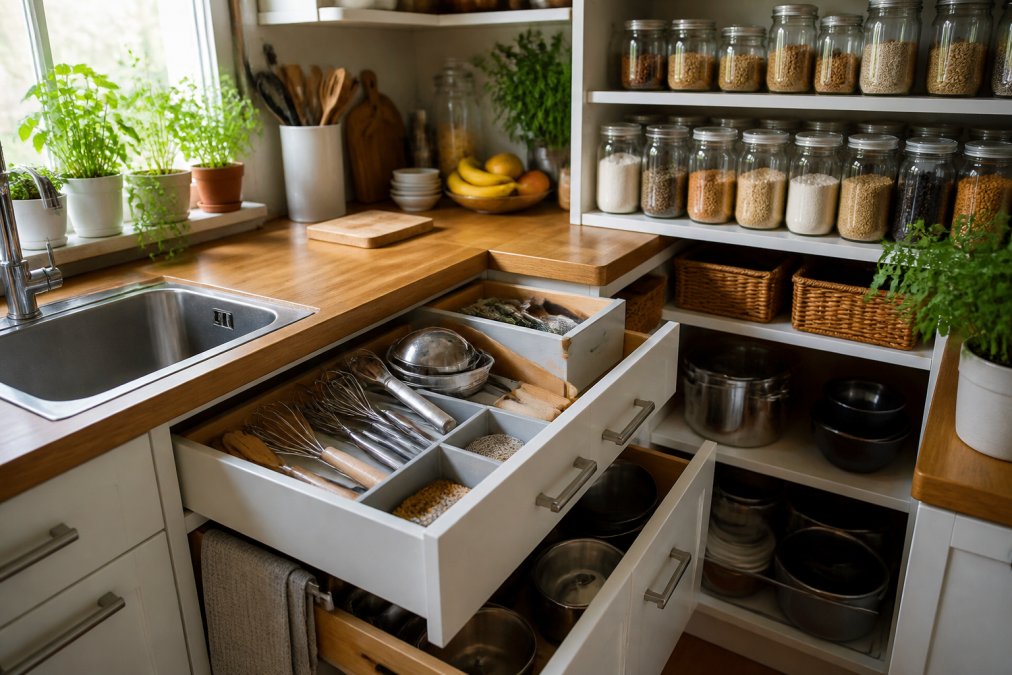
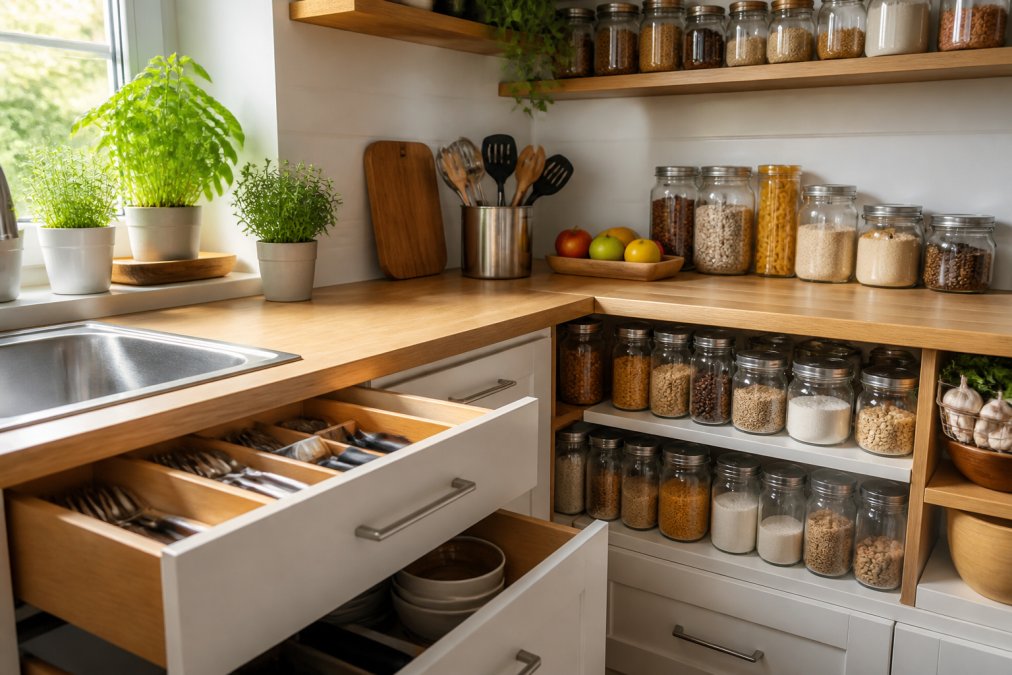
Start by identifying what you use weekly. Kitchen tools you use daily should be within arm's reach of your cooking zone. Measuring cups, knives, cutting boards, and wooden spoons live on the counter or in the most accessible drawer.
Vertical storage multiplies your space. Wall-mounted magnetic strips hold knives. Hooks under cabinets hang frequently used items. Stackable containers in drawers organize utensils by function. When your tools are easy to reach, you use them.
Label your pantry containers. This single action changes behavior. When you can see that you have oats, beans, rice, and pasta at a glance, you're more likely to use them. Clear glass or plastic containers with labels cost little but create dramatic improvements in how you approach meal planning.
Group similar items together. All measuring tools in one drawer. All cooking utensils in one container. All small appliances in one cabinet. This saves time and reduces frustration.
Smart Shopping: Durability and Maintenance on a Budget
Buying cheap kitchen gadgets repeatedly costs more than investing in durable tools once. Stainless steel lasts longer than plastic. Cast iron, properly maintained, lasts generations. Non-stick degrades. Cheap knives dull quickly.
Maintenance extends the life of your tools. A knife honed regularly stays sharp far longer than one that's neglected. Stainless steel cookware cleaned properly resists staining and pitting. Cast iron seasoned and stored correctly becomes more valuable with age.
Research before buying. Read reviews from people who've owned the item for years, not weeks. Look for tools with replaceable parts. Buy from sources with reasonable return policies. At Hutch's Beauty Boutique, we understand that quality matters, and we curate selections across all product categories, including kitchen and home organization tools, to balance affordability with durability, so you're investing in items that actually last.
Second-Hand and Thrifted Kitchen Gear Worth Buying
Second-hand shopping dramatically extends your budget while often yielding higher-quality items than new budget alternatives. Vintage stainless steel cookware, cast iron, and solid kitchen tools are often cheaper used than new versions.
Cast iron is an exceptional second-hand purchase. Vintage cast iron is often superior to new versions and costs a fraction of new prices. Even heavily rusted cast iron can be restored.
Stainless steel cookware holds value. A used set from a reputable brand often costs less than half the original price and has years of life remaining. Check for dents (cosmetic, not functional) and verify that lids fit properly.
Avoid second-hand non-stick cookware. You can't assess the condition of the non-stick coating, and damaged coatings create health concerns.
Small appliances are hit-or-miss. A used slow cooker or pressure cooker from a reputable brand is usually reliable. Test it if possible. Blenders and food processors are often available used at significant discounts; verify that they power on and that blades move freely.
Thrift stores, estate sales, and online marketplaces are your sources. Inspect items for damage, verify electrical appliances work, and don't hesitate to pass on anything questionable.
| Tool Category | Best for Budget | Durability | When to Buy New |
|---|---|---|---|
| Stainless Steel Cookware | Second-hand | 20+ years | Only if unavailable used |
| Non-Stick Cookware | New | 3-5 years | Always new for safety |
| Cast Iron | Second-hand | Generations | Only specialty pieces |
| Chef's Knife | New | 10+ years | Condition matters too much |
| Small Appliances | Second-hand | 5-10 years | Test before purchasing |
| Measuring Tools | Either | 20+ years | Negligible difference |
Building a kitchen for healthy cooking on a budget comes down to intentionality. You're not shopping for gadgets, you're shopping for tools that change behavior. A sharp knife makes vegetable prep faster. A food thermometer makes protein cooking safer. A slow cooker makes batch cooking practical. Start with essentials, add tools that solve specific problems in your routine, and avoid everything else. This approach keeps your kitchen functional, your budget intact, and your cooking consistent. At Hutch's Beauty Boutique, we recognize that wellness extends to every part of your daily routine, including the kitchen tools that support healthy meal preparation. Explore our curated selection of kitchen gadgets and home organization essentials designed to make healthy cooking accessible and affordable.
Frequently Asked Questions
What are the best kitchen gadgets for healthy cooking on a budget?
Focus on multi-purpose tools that improve nutrition outcomes: a quality chef's knife for proper cutting, a food thermometer for food safety, measuring cups for portion control, and a slow cooker or pressure cooker for nutrient retention through batch cooking. Skip unitaskers and gadgets that duplicate what you already own. Prioritize durability over trendy designs, tools that last longer deliver better value.
How do I prioritize kitchen gadget purchases on a limited budget?
Start by identifying which culinary essentials directly support your meal preparation habits. If you batch cook, a pressure cooker saves time and energy. If portion control matters, invest in measuring tools. Buy one high-quality item at a time rather than many cheap ones. Check thrift stores and secondhand marketplaces for durable pieces like stainless steel cookware that hold up well over time.
Are expensive kitchen gadgets worth the investment for healthy eating?
Not always. A $200 specialty gadget that sits unused wastes money. Mid-range stainless steel cookware and basic tools often outperform budget versions in heat distribution and longevity. Spend more on items you'll use daily, a good knife, durable pans, measuring tools, and less on single-purpose gadgets. Quality matters for ergonomic design and food safety, but brand prestige doesn't guarantee better nutrition outcomes.
What kitchen gadgets should I avoid buying?
Skip unitaskers that duplicate existing tools: egg cookers, single-use steamers, or specialty choppers when a chef's knife works fine. Avoid low-quality non-stick cookware that sheds coating. Don't buy gadgets marketed as 'health solutions' without evidence. Steer clear of overly complex appliances with features you'll never use. Instead, invest in versatile tools like a food processor or slow cooker that handle multiple cooking methods and support batch cooking.
This article was written using GrandRanker


