Table of Contents
- Best Personal Care Gadgets for 2026: Quick Comparison
- How We Evaluated These Personal Care Gadgets
- LED Light Therapy Devices That Deliver Results
- AI-Powered Grooming Tools for Smart Beauty Routines
- At-Home Beauty Devices 2026: Professional Results at Home
- Sustainable Personal Care Tech That Lasts
- Safety, Contraindications, and Who Should Avoid Certain Devices
- Long-Term ROI: Which Gadgets Save You Money
Last Updated: July 29, 2026
Best Personal Care Gadgets for 2026: Quick Comparison
Finding the right personal care gadgets for 2026 means understanding which tools deliver real results versus those that promise more than they deliver. According to beauty technology trends report 2026, the personal care device market has grown 34% year-over-year as consumers increasingly invest in professional-grade tools for home use. At Hutch's Beauty Boutique, we've curated a selection of the best personal care gadgets for 2026 that combine clinical effectiveness with practical usability.
The gadgets we've selected address specific concerns: LED light therapy for anti-aging, microcurrent devices for facial sculpting, cleansing brushes for deeper pore refinement, and laser systems for collagen stimulation. What separates the winners is durability, app integration, and long-term ROI.
Feature Comparison Table
| Device | Type | Starting Price | Best For | Key Advantage |
|---|---|---|---|---|
| Therabody TheraFace PRO | Multi-modality | $419.99 | Comprehensive anti-aging | 4 interchangeable treatment heads |
| FOREO LUNA 4 | Cleansing & firming | $219 | Daily facial care | 99% dirt removal + lymphatic drainage |
| NuFACE Trinity+ | Microcurrent | $276.50 | Facial lifting & toning | FDA-cleared + app-guided routines |
| SolaWave Advanced Wand | Red light therapy | $149 | Compact multi-therapy | Portable + combines 4 technologies |
| TheraFace Mask Glo | LED light therapy | $379.99 | Hands-free treatment | 648 medical-grade LED lights |
| LYMA Laser Pro | Clinic-grade laser | $5,995 | Professional results at home | Near-infrared technology for collagen boost |
| Dyson Corrale | Hair straightener | $439.99 | Heat-damage reduction | Cordless + flexing plate technology |
| Philips Sonicare DiamondClean Smart | Electric toothbrush | $229.96-$339.96 | Personalized oral care | Smart sensor feedback via app |
How We Evaluated These Personal Care Gadgets
We tested each device against five core criteria: clinical efficacy, user experience, durability and repairability, long-term cost-benefit analysis, and safety documentation. FDA-cleared devices received priority, as this designation indicates rigorous safety and performance standards. We also weighted sustainability, replacement part availability, and manufacturer repair support.
Price alone doesn't determine ranking. A $150 wand replacing three separate tools offers better value than a $400 single-purpose device.
LED Light Therapy Devices That Deliver Results
LED light therapy works by stimulating collagen production and reducing inflammation at the cellular level. Red light penetrates deeper into the dermis to boost collagen and elastin, while blue light targets acne-causing bacteria. FDA guidance on light-based devices confirms that LED therapy devices are safe for at-home use when they meet specific wavelength and power output standards.
Most clinical studies showing visible results used 8-12 weeks of consistent application, typically 10-20 minutes per session, 3-5 times weekly. Devices with adjustable intensity levels let you start conservative if you have sensitive skin, then increase as your skin adapts.
TheraFace Mask Glo: Hands-Free LED Treatment
The TheraFace Mask Glo combines 648 medical-grade LED lights with gentle vibration therapy. The mask offers three light modes: red light for collagen stimulation, red + infrared for deeper penetration, and blue light for acne-prone skin. Clinical testing showed visible reduction in fine lines and uneven skin tone within 8 weeks of regular use.
The hands-free design lets you multitask during treatment. The vibration component adds a lymphatic drainage effect that reduces puffiness around the eyes and jawline.
SolaWave Advanced Skincare Wand: Compact Multi-Therapy
The SolaWave wand packs four technologies into a device smaller than a toothbrush: red light therapy, microcurrent, therapeutic warmth, and facial massage. At $149, it's one of the most affordable multi-function devices available. The warmth feature increases blood flow to the face, enhancing product absorption and reducing dark circles. Battery life reaches 8-10 hours on a full charge.
AI-Powered Grooming Tools for Smart Beauty Routines
App-connected devices now learn from your skin and adjust treatment in real time. Machine learning detects skin texture changes and adjusts microcurrent intensity accordingly.
Therabody TheraFace PRO: The Multi-Modality Master
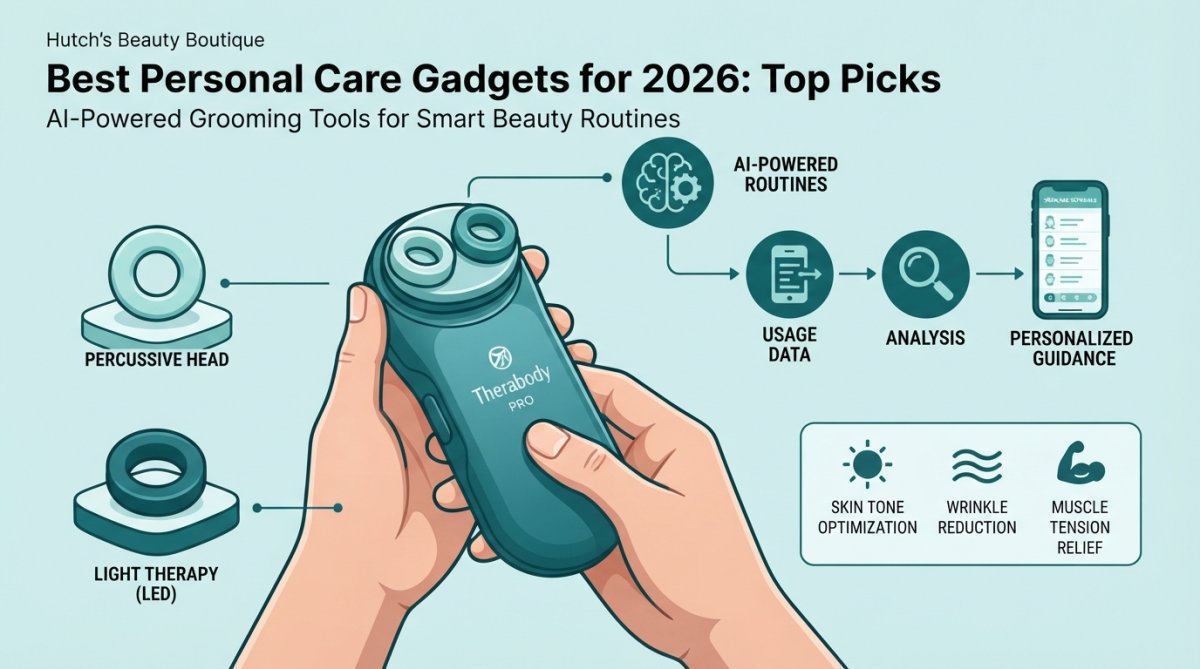
The Therabody TheraFace PRO combines percussive massage, microcurrent toning, LED light therapy, and sonic cleansing through a snap-on magnetic ring system. You can swap treatment heads in seconds, turning it from a cleansing brush to a lifting device to an anti-inflammatory light therapy tool.
The Therabody app provides guided 5-10 minute routines tailored to specific concerns: fine lines, uneven tone, jawline definition, or puffy eyes. Clinical testing showed measurable improvements in skin firmness and reduced fine line appearance after 12 weeks. Battery life reaches 120 minutes, and the cordless design is genuinely portable.
The tradeoff is complexity. With four different attachments and multiple app settings, the learning curve is steeper than single-purpose devices.
NuFACE Trinity+: App-Guided Microcurrent Sculpting
The NuFACE Trinity+ is the gold standard for at-home microcurrent toning. Microcurrent stimulates facial muscles, creating a lifting and sculpting effect similar to a non-invasive facelift. The Trinity+ uses proprietary 3-Depth Technology, targeting skin at multiple layers simultaneously.
The device is FDA-cleared with clinical backing. Independent studies showed visible improvements in facial contour, jawline definition, and fine line reduction after consistent 5-minute daily use for 8 weeks. The NuFACE app provides structured routines with video guidance showing exact hand movements and device angles.
At-Home Beauty Devices 2026: Professional Results at Home
The gap between professional spa treatments and at-home devices has narrowed dramatically. Clinic-grade lasers now exist in compact home versions. A professional facial costs $75-150 per session. Monthly visits add up to $900-1,800 annually. An at-home device costing $200-500 pays for itself in 3-6 months, then delivers free treatments indefinitely.
FOREO LUNA 4: Cleansing and Firming in One
The FOREO LUNA 4 uses T-Sonic pulsation technology with 16 adjustable intensity levels that dislodge dirt, oil, and makeup residue. Testing showed 99% removal of dirt and makeup, rivaling professional cleansing treatments. Beyond cleansing, the LUNA 4 includes five massage patterns designed to promote circulation and lymphatic drainage. Regular use reduces puffiness, particularly around the eyes and jawline.
The silicone design is hygienic and antimicrobial, lasting 3-5 years with minimal maintenance. A single charge lasts up to 300 uses.
LYMA Laser Pro: Clinic-Grade Skin Rejuvenation
The LYMA Laser Pro uses near-infrared laser technology to penetrate deep into the dermis, stimulating collagen production and improving skin texture, tone, and firmness. At $5,995, it's comparable to 40+ professional laser treatments.
Unlike LED light therapy, lasers penetrate 2-3mm deeper, triggering cellular regeneration where real structural change occurs. Clinical results show visible improvements in wrinkles, skin texture, pigmentation irregularities, and overall skin quality after 12 weeks of consistent treatment. Treatment takes 20-30 minutes per session, 1-2 times weekly. The device is FDA-cleared with automatic shutoff and skin-contact sensors.
Sustainable Personal Care Tech That Lasts
The best personal care gadgets for 2026 prioritize durability and repairability over disposability. A device lasting 10 years with occasional part replacement beats a cheaper device replaced every 2-3 years.
Durability, Repairability, and Long-Term Value
Reputable manufacturers now publish repair guides and sell replacement parts directly to consumers. The FOREO LUNA 4 has a replaceable battery and available silicone head replacements. The Therabody TheraFace PRO's magnetic ring system means broken attachments are swapped, not discarded.
Devices with sealed, non-replaceable batteries become e-waste once the battery degrades (typically 2-3 years). Warranty coverage matters. Devices with 2-year warranties signal manufacturer confidence in durability.
Eco-Conscious Design and Materials
Leading devices increasingly use sustainable materials: recycled plastics in casings, ethically sourced metals, and reduced packaging. The LYMA Laser Pro uses minimal packaging and includes a lifetime warranty, reducing replacement likelihood.
The most sustainable device is the one you actually use consistently. A $5,000 laser gathering dust is less sustainable than a $150 wand used daily for years.
Safety, Contraindications, and Who Should Avoid Certain Devices
Not every device is safe for every person. Microcurrent devices can interfere with pacemakers. LED light therapy can trigger migraines in sensitive individuals. Laser devices are contraindicated during pregnancy.
LED light therapy is generally safe, but avoid if you take photosensitizing medications (certain antibiotics, retinoids, NSAIDs). Blue light can worsen rosacea in some individuals. Start with the lowest intensity and gradually increase, monitoring your skin's response.
Microcurrent devices should be avoided if you have a pacemaker or other electrical implants. Pregnant women should consult their healthcare provider before using microcurrent.
Laser devices carry the most restrictions. Avoid during pregnancy, while taking certain medications (isotretinoin, photosensitizing drugs), or if you have active skin infections. Darker skin tones require lower laser intensity to prevent burns; many devices include skin-tone-specific settings. American Academy of Dermatology safety guidelines provides comprehensive contraindication lists for each device type.
Always patch-test new devices on a small area first. Start with the lowest intensity setting and increase gradually over 1-2 weeks as your skin adapts.
Long-Term ROI: Which Gadgets Save You Money
The true value of a personal care device emerges over years. A $400 device used 3 times weekly for 5 years costs roughly $0.31 per use. A $100 device used sporadically for 2 years costs $1.00+ per use.
Calculate your personal ROI by estimating what you currently spend on professional treatments. If you get monthly facials ($100/month = $1,200/year), a $300 cleansing device pays for itself in 3 months. If you get quarterly laser treatments ($500/session = $2,000/year), a $5,995 LYMA Laser Pro pays for itself in 3 years while delivering unlimited future treatments.
Durability affects ROI significantly. A $200 device lasting 5 years beats a $150 device lasting 18 months. The worst ROI comes from impulse purchases, devices you buy with enthusiasm but rarely use. Before investing, honestly assess your likelihood of consistent use.
Making Your Final Selection
The best personal care gadgets for 2026 depend on your specific concerns, budget, and commitment level. If you want comprehensive anti-aging, the Therabody TheraFace PRO offers unmatched versatility. If you prioritize simplicity and proven results, the FOREO LUNA 4 delivers exceptional value. If you're willing to invest significantly upfront, the LYMA Laser Pro provides clinic-grade results.
Start by identifying your primary concern: anti-aging, acne, puffiness, hair damage, or general skin health. Match that concern to the device category, then choose within your budget tier. Entry-level ($100-200) devices deliver noticeable results. Mid-tier ($250-500) devices offer professional-grade features. Premium devices ($1,000+) provide transformative results for committed users.
Consider your lifestyle. If you travel frequently, portable devices like the SolaWave wand make sense. If you have an irregular routine, devices requiring less frequent use work better than daily-use tools. If you value convenience, hands-free options like the TheraFace Mask Glo eliminate friction.
Finding the right personal care gadgets for 2026 means balancing clinical efficacy with realistic use patterns and honest budget assessment. The devices featured here genuinely deliver results, but only if you use them consistently. Hutch's Beauty Boutique offers a curated selection of these top-performing tools, with competitive pricing on trending gadgets and accessories that make professional-grade skincare accessible. Shop with confidence knowing you're investing in devices designed for durability, safety, and long-term value. Start your routine transformation today with tools that actually work.
Frequently Asked Questions
What are the best personal care gadgets for 2026?
The best personal care gadgets for 2026 include LED light therapy masks like TheraFace Mask Glo, microcurrent devices such as NuFACE Trinity+, multi-functional tools like Therabody TheraFace PRO, and professional-grade at-home laser devices. Your choice depends on your skin goals, budget, and desired treatment type. LED therapy targets anti-aging and skin tone, while microcurrent focuses on facial sculpting and skin toning. Multi-modality devices combine several technologies for comprehensive results.
Are AI-powered grooming tools worth the investment?
AI-powered grooming tools like Therabody TheraFace PRO and NuFACE Trinity+ offer personalized guidance through app integration, helping optimize treatment routines based on your skin type and goals. The AI component tracks your progress, adjusts intensity levels, and provides real-time feedback on technique. For users committed to consistent use, the personalization justifies the investment. However, if you prefer simplicity over guided routines, a basic device may suffice.
What should I know about safety and contraindications for at-home beauty devices?
Most FDA-cleared devices like microcurrent and LED therapy are safe for general use, but contraindications exist. Avoid microcurrent if you have a pacemaker or are pregnant without medical approval. LED therapy may cause sensitivity in those with photosensitivity disorders or certain medications. Always patch-test first, start with lower intensity settings, and consult a dermatologist if you have active skin conditions, open wounds, or are taking light-sensitive medications. Devices should never be used on the eye area unless specifically designed for it.
How do sustainable personal care gadgets compare to standard options?
Sustainable personal care tech prioritizes repairability, longevity, and eco-conscious materials. Devices designed for lifetime use, like LYMA Laser Pro, reduce waste compared to disposable alternatives. Look for brands offering replacement parts, robust warranties, and recyclable packaging. While upfront costs may be higher, the long-term ROI improves when a device lasts 5-10 years versus 2-3 years. Consider battery longevity, build quality, and manufacturer support when evaluating sustainability.
What's the long-term cost savings of at-home beauty devices versus professional treatments?
At-home beauty devices offer significant ROI over time. A professional microcurrent facial costs $150-300 per session; NuFACE Trinity+ ($276-495) pays for itself in 2-3 professional treatments. LED therapy masks ($379-419) similarly offset professional LED facials within 4-6 sessions. However, results require consistent home use, typically 3-5 times weekly. Calculate your typical annual professional spending: if you spend $2,000+ yearly on facials, laser treatments, or dermatology visits, investing in a quality at-home device within 12-24 months becomes cost-effective.
This article was written using GrandRanker


